
- Para 83, Opinions adopted by the Working Group on Arbitrary Detention at its 100th session, 26–30 August 2024
The Working Group on Arbitrary Detention is one of the thematic special procedures overseen by the United Nations Human Rights Council. It focuses on arbitrary detention, including instances in which States imprison or otherwise detain individuals in a manner not allowed by law or without respecting due process guarantees. The Working Group communicates with governments through urgent appeals and communications, aiming to prevent unlawful imprisonment and guide countries toward fairer legal practices.
Arbitrary detention refers to deprivation of liberty that is not only unlawful but also unreasonable, disproportionate, or lacking due process. It covers situations where detention, even if legal on paper, is applied in a way that is unjust, unpredictable, or inappropriate.
The Working Group applies this definition to 5 categories:

A violation under this category occurs when there is no legal basis to justify the deprivation of liberty. For instance, if a person is detained without charges or court orders.
A violation under this category occurs when the detention is used in a response to the legitimate exercise of human rights, such as the exercise of the right to freedom of opinion and expression, or freedom of assembly and association.

A violation under this category occurs when the international norms relating to the right to a fair trial are totally or partially not observed. Some of these rights include the right to a public hearing, right to a legal counsel, and the right to be tried without undue delay.
A violation under this category occurs when asylum seekers, immigrants, or refugees are subjected to prolonged administrative custody without the possibility of administrative/judicial review or remedy.
A Category V violation occurs when the deprivation of liberty violates international law for reasons of discrimination based on: Birth; national, ethnic or social origin; language; religion; economic condition; political or other opinion; gender; sexual orientation; or disability or other status.
In Thailand, exercising your right to freedom of expression and peaceful assembly can land you in prison for years, or even decades. Giving peaceful public speeches advocating for monarchy reforms, conducting public opinion polls about the monarchy, and wearing traditional Thai costumes at a mock fashion show have been criminalized by Thai courts. In early 2024, an activist from Chiang Mai was sentenced to a record-breaking 50 years in prison under the lèse-majesté law for sharing 27 posts about the monarchy on Facebook. Some of the clips that he shared include clips of John Oliver’s Last Week Tonight Show and TV sitcom American Dad.
The Working Group on Arbitrary Detention has consistently stressed that detaining people for exercising this fundamental right is a violation of international law, and urges the immediate release of people arbitrarily deprived of their freedom, calling the use of the lèse-majesté law “gravely concerning.”
And yet, dozens of people remain behind bars today for merely speaking their mind. They are ordinary, everyday Thai citizens who peacefully exercised their freedom of expression and speech – an act the Thai government deems equivalent to the crime of manslaughter or kidnapping of a minor.
They are mothers and fathers, brothers and sisters, children and seniors. At times, they are detained even before their trial or appeal takes place, violating the principle of presumption of innocence. They go on hunger strike, and sometimes even die in prison. The Working Group has communicated at least 16 times to the Thai government about the pressing issue of arbitrary detention of political prisoners, but as of 2025 the situation remains grim.
In response to this urgent and ongoing crisis, Freedom Bridge was established to support individuals affected by arbitrary detention and other human rights violations in Thailand. The organization provides psychosocial and advocacy support for those whose fundamental freedoms have been curtailed. It also works to raise awareness about patterns of arbitrary detention and restrictions on civil and political rights, while coordinating with international networks to strengthen protection and solidarity for those at risk. More information is available at Freedom Bridge.
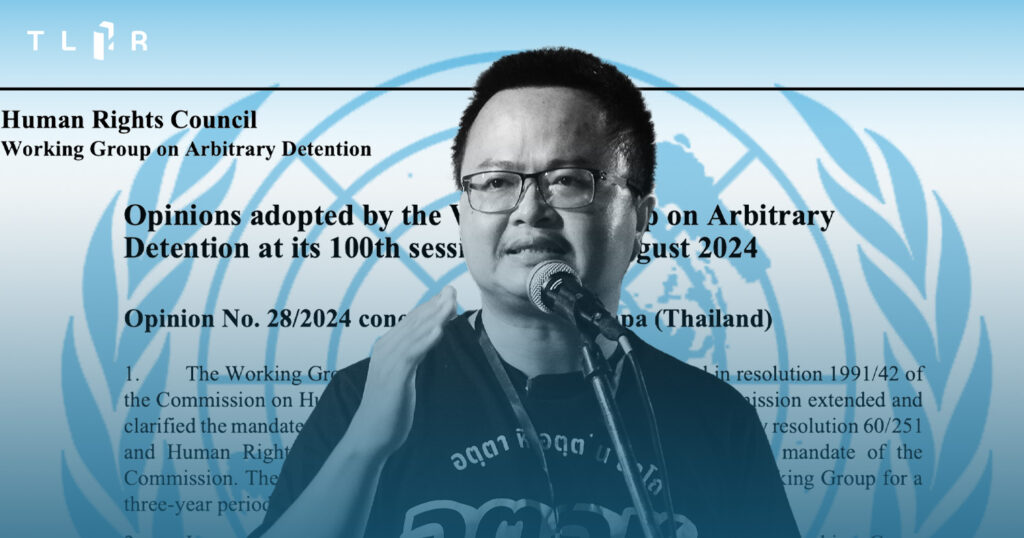
On 9 October 2024, the WGAD sent a communication to the Thai government concerning the arbitrary detention of human rights lawyer and pro-democracy activist, Arnon Nampa under Section 112 (lèse-majesté) of the Criminal Code. In the communication, the WGAD found that his deprivation of liberty is arbitrary under categories I, II, III, and V.
Category I: Because his pretrial detention violated his right to liberty pending trial and his detention lacks a legal basis.
Category II: Because his detention stems directly from the legitimate exercise of his right to freedom of expression.
Category III: Because he was not afforded fair trial and due process as required under international standards.
Category V: Because his deprivation of liberty is discriminatory under international law (on the basis of political or other opinions).