
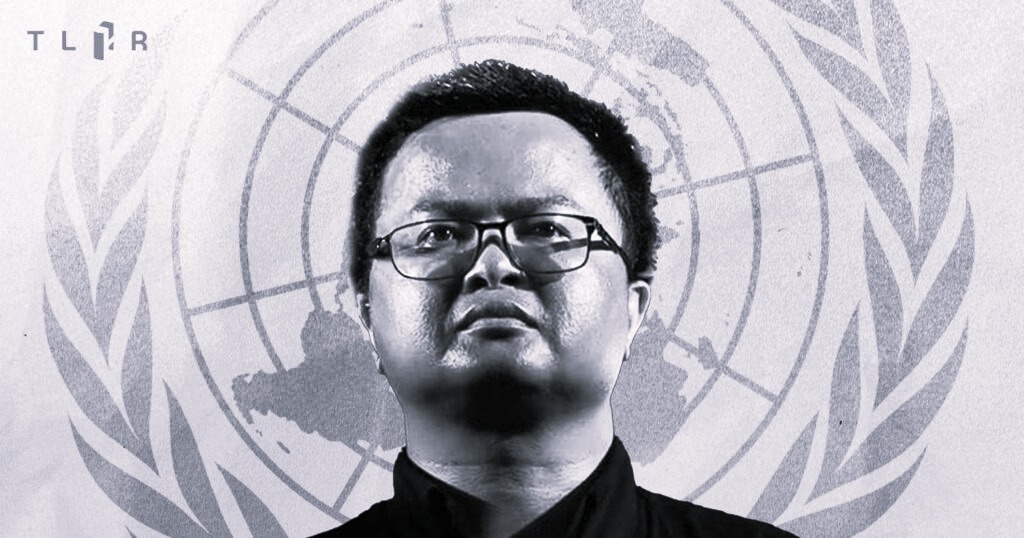
No. 28/2024: Arnon Nampa
Victim Name:
Arnon Nampa
Detention Status:
Ongoing
Date of Adoption:
9 October 2024
Categories:
- Category I: Detention without legal basis
- Category II: Detention resulting from the exercise of fundamental freedoms guaranteed by international law
- Category III: Violation of the right to a fair trial leading to detention
- Category V: Detention resulting from discrimination on the grounds of ethnic origin, political opinion, etc.
Overview & Facts
Information on the Violation of Rights
.
Case 1: Black Case No. Aor.2495/2564
- In this case, Arnon was charged under the Criminal Code Section 112 for participating in the assembly on 14 October 2020, where he was accused of giving a speech demanding the Prime Minister’s resignation, constitutional amendment, and reform of the monarchy.
- On 7 October 2021, the public prosecutor indicted Arnon on the charge under Section 112 of the Criminal Code, which was Arnon’s 10th Section 112 case. Between 7 October 2021, and 22 February 2022, Arnon submitted 8 bail requests. In the first 7 requests, the Criminal Court denied bail. In the first denial, the Court reasoned that, considering the severity of the charges and the circumstances of the case, the charges carried a high penalty. Furthermore, the defendant was facing multiple cases in this court, some of which the Court did not allow provisional release during trial. If provisional release were granted, he might flee.
- Finally, the Court granted Arnon’s 8th bail request at 100,000 THB, following a pre-trial detention period of 139 days, with the following conditions:
-
- Prohibited from engaging in any activity or act that might cause damage to the monarchy and the Court in all aspects, including prohibiting any act that obstructs the judicial process.
- Prohibited from participating in any assembly that might cause chaos in the country.
- Must wear an electronic monitoring device (EM).
- Prohibited from leaving his residence between 9:00 PM and 6:00 AM, unless necessary for medical treatment, education, going to a police station, public prosecutor’s office, or court, or with the Court’s permission.
- Prohibited from travelling outside the kingdom unless permitted by the Court.
- On 26 September 2023, the Criminal Court sentenced Arnon, finding him guilty under the Criminal Code Section 112, with a penalty of 4 years imprisonment and a fine of 20,000 THB, and also under the Emergency Decree on Public Administration in Emergency Situations B.E. 2548 (2005). Following the judgment, Arnon submitted a request for bail to the Criminal Court, which was forwarded to the Appeals Court for consideration.
- On 30 September 2023, the Appeals Court denied Arnon’s bail request, reasoning that after considering the severity of the charges and the circumstances of the case, together with the evidence in the file, the defendant’s actions affected and damaged the democratic system with the King as Head of State. The circumstances were severe. The Court of First Instance sentenced him to 4 years imprisonment. If provisional release were granted, there was reason to believe the defendant might flee, thus denying provisional release during the appeal. The request was dismissed.
.
Case 2: Black Case No. Aor. 2804/2564
- In this case, Arnon was charged under the Criminal Code Section 112 and the Computer Crimes Act Section 14(3) for publishing 3 posts on social media:
-
- The first post questioned why the decline of faith in the monarchy was an offense.
- The second post questioned the necessity of enforcing Section 112 against dissidents.
- The third post questioned those who disagree with the reform of the monarchy.
- On 24 December 2021, the Court denied Arnon’s bail request, which had been submitted since 2 December 2020, reasoning that Arnon’s expression might cause chaos in the country, and Arnon had been accused of similar offenses in this and other courts in multiple cases. If provisional release were granted, Arnon might commit similar acts or cause other dangers. In the second bail request, on 22 February 2022, the Court ordered provisional release, using a bail bond of 100,000 THB, along with strict conditions.
- On 17 January 2024, the Court sentenced Arnon, finding him guilty under the Criminal Code Section 112 and the Computer Crimes Act Section 14(3), with a penalty of 4 years imprisonment, and ordering the sentence to run consecutively with the first case.
- On 16 February 2024, Arnon submitted a request for bail, which was forwarded to the Appeals Court. Later, the Appeals Court denied bail, reasoning that the defendant’s actions affected and damaged the democratic system with the King as Head of State. The circumstances were severe. The Court of First Instance sentenced him to 4 years imprisonment consecutively. If provisional release were granted, there was reason to believe the defendant would flee, thus denying provisional release during the appeal.
.
(Information as of 16 November 2025)
WGAD Opinions
Arbitrary Detention under Category I: Lack of Legal Basis
- The Working Group on Arbitrary Detention is of the opinion that the detention of Arnon Nampa constitutes arbitrary detention under Category I because Section 112 is not considered a legal basis that can justify the deprivation of Arnon’s liberty.
- The Working Group explains that the principle of legality requires that the law must have a clear definition, and the general public must be able to access and understand the law; otherwise, the general public will not be able to conform their conduct to the law.
- Considering Section 112, the law enforced in Arnon Nampa’s detention, the Working Group is of the opinion that Section 112 is vague and overly broad. That is, Section 112 lacks a clear definition of what expressions constitute defaming, insulting, or threatening the monarchy. Therefore, the enforcement of Section 112 relies entirely on the discretion of officials in interpreting which actions fall under Section 112.
- Furthermore, the Working Group is of the opinion that the detention of Arnon Nampa during trial for more than 200 days (at least 139 days from the speech in the #Mob14Oct assembly at Democracy Monument case and at least 100 days from the 3 Facebook posts case in January 2021) is detention without a legal basis.
- The Working Group explains that Article 9(3) of the International Covenant on Civil and Political Rights (ICCPR) establishes the principle that pre-trial detention shall not be the general rule. If pre-trial detention is necessary, such measures must be implemented for the shortest possible duration, and must be based on an individualized determination of necessity and reasonableness, considering all circumstances, and must be for the purposes of preventing flight, interference with evidence, and re-offending.
- The Court should consider whether there are other measures that can be enforced instead of pre-trial detention so that detention is not necessary in such cases, such as granting bail or other conditions. Furthermore, the decision to order pre-trial detention should not be based on the penalty the person might receive, but should be based on necessity.
- The Working Group finds that the order to detain Arnon Nampa during trial for over 200 days was not based on an individualized determination and the principle of necessity or reasonableness. Thus, the detention lacked a legal basis.
- The Working Group also noted that even when Arnon Nampa was granted bail, he was subject to strict bail conditions, such as wearing an EM bracelet and prohibition from leaving his residence between 9:00 PM and 6:00 AM, which resembled house arrest. Therefore, Arnon Nampa was considered deprived of liberty even while on bail at that time.
.
Arbitrary Detention under Category II: Exercise of Fundamental Freedoms under International Law
- The Working Group on Arbitrary Detention is of the opinion that the detention of Arnon Nampa constitutes arbitrary detention under Category II because it violates Article 19 of the ICCPR, which protects freedom of expression, meaning Arnon Nampa’s detention resulted from the exercise of freedom of expression, which is legitimate as it pertains to matters of public interest.
- The Working Group on Arbitrary Detention considers that Arnon Nampa’s speeches, whether at physical assemblies or online, fall within the scope of exercising the right to freedom of expression protected by Article 19 of the ICCPR and Article 19 of the UDHR. All public figures, including those in the highest political authority such as Heads of State and Government, are legitimately subject to criticism and political opposition, and the law should not have more severe penalties based only on the status of the person who might be alleged.
- When considering the principles under Article 19(3) of the ICCPR, the exercise of the right to freedom of expression may be subject to restrictions, but such restrictions must be (1) Provided by law, (2) Must be consistent with legitimacy (in cases such as the protection of national security, public order, public health, or public morals), and (3) Such restrictions must adhere to the principles of necessity and proportionality.
- The Thai Government previously argued that the lèse-majesté law, which restricts freedom of expression, is for the preservation of public order and national security. However, the Working Group rejected this argument, concluding that “it cannot be maintained that Arnon Nampa’s actions threatened the rights or reputation of others, national security, public order, public health, or public morals.”
- Furthermore, the Working Group also noted that the Thai Government did not explain the reasons why the arrest, detention, and prosecution of Arnon Nampa resulting from the exercise of freedom of expression and peaceful assembly were appropriate and proportionate. It also noted that the detention of individuals under lèse-majesté proceedings in Thailand follows a pattern, meaning the detention of individuals who peacefully express dissent against the lèse-majesté law through freedom of expression.
.
Arbitrary Detention under Category III: Violation of International Norms concerning the Right to a Fair Trial
- The Working Group on Arbitrary Detention is of the opinion that the detention of Arnon Nampa constitutes arbitrary detention under Category III because the relevant officials were unable to comply with the international standard of due process, which is a minimum standard. According to international law, including the Universal Declaration of Human Rights and Articles 9(3) and 14(3)(c) of the ICCPR, the principle established in cases of arrest or detention on criminal charges is that everyone shall be entitled to trial within a reasonable time and without undue delay.
- From the case of the speech in the #Mob14Oct assembly at Democracy Monument, where Arnon Nampa was detained pre-trial for over 139 days, and received his first trial hearing on 20 June 2023, which was over 916 days since the first day of prosecution. And the case of the 3 Facebook posts in January 2021, where Arnon Nampa was detained pre-trial for over 100 days, and received his first trial hearing on 21 April 2023, which was over 667 days since the first day of prosecution.
- For these reasons, the Working Group on Arbitrary Detention considers that the detention of Arnon Nampa under Section 112 violates Articles 9(3) and 14(3)(c) of the ICCPR, and also contravenes Principle 38 of the Body of Principles for the Protection of All Persons under Any Form of Detention or Imprisonment.
.
Arbitrary Detention under Category V: Detention Resulting from Discrimination on the Grounds of Ethnic Origin, Political Opinion, etc.
- The Working Group on Arbitrary Detention has considered that the arbitrary detention of Arnon Nampa resulted from the exercise of freedom of expression in his capacity as a human rights defender, including the exercise of civil and political rights and other opinions. The deprivation of such rights and freedoms may be presumed to be a deprivation of liberty that contravenes international law on the basis of discrimination based on political or other opinions.
- Therefore, the detention of Arnon Nampa violates Articles 2 and 7 of the UDHR and Articles 2(1) and 26 of the ICCPR, as it is discrimination based on political or other opinions and his status as a human rights defender.
- Furthermore, the Working Group on Arbitrary Detention noted that Arnon Nampa’s opinions were the core issue of the aforementioned case, and the relevant officials displayed a discriminatory attitude. That is, the discrimination against Arnon Nampa is evident from the prosecution of Arnon Nampa stemming from his human rights activities in over 26 cases, 14 of which were prosecuted under Section 112, the prolonged duration of Arnon Nampa’s detention, and the creation of difficult and complicated bail conditions.
WGAD Requests to the Thai Government
- Has Arnon been released, and if so, on what date?
- Has any compensation or other remedy been provided to Arnon?
- Has any investigation been conducted into the violations of Arnon’s rights, and if so, what were the results of the investigation?
- Have any laws or practices been amended or changed to bring Thailand’s laws and practices into line with its international obligations and the present opinion?
- Have any other measures been taken to give effect to this opinion?
International LEGAL FRAMEWORK:
- International Covenant on Civil and Political Rights (ICCPR)
- Article 9: Right not to be subjected to arbitrary arrest or detention
- Article 14: Right to a fair trial
- Article 19: Right to freedom of opinion and expression
- Article 26: Principle of equality before the law and non-discrimination
- Universal Declaration of Human Rights (UDHR)
- Article 9: Prohibition of arbitrary arrest, detention, or exile.