
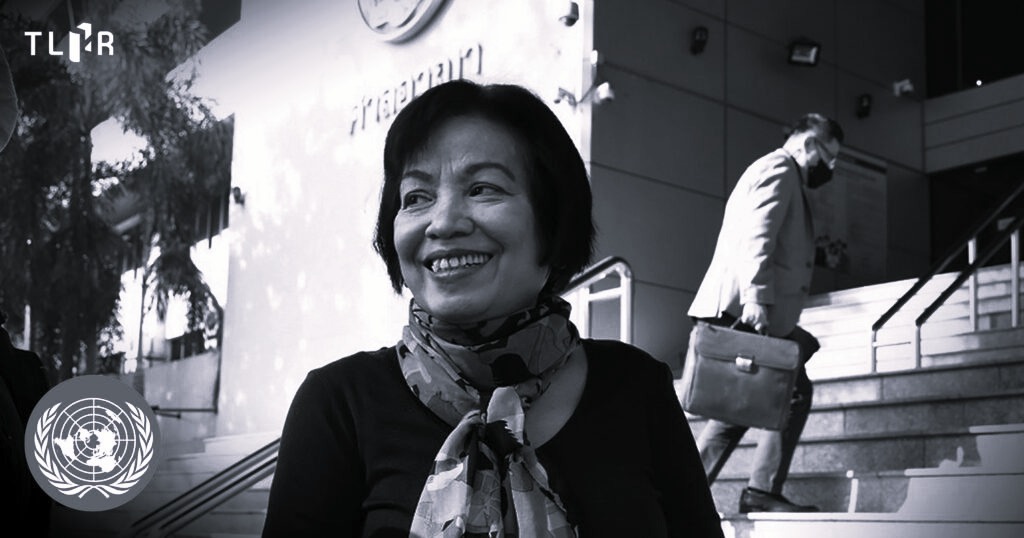
No. 64/2021: Anchan Preelert
Victim Name:
Anchan Preelert
Detention Status:
Released
Date of Adoption:
27 January 2022
Categories:
- Category 1: Detention without legal basis
- Category 2: Detention resulting from the exercise of fundamental freedoms guaranteed by international law
- Category 3: Violation of the right to a fair trial, leading to detention
Overview & Facts
Information on the Violation of Rights
Anchan Preelert, a former civil servant, was charged under the Criminal Code, Section 112 (lèse-majesté), and the Computer Crime Act, Section 14 (2), (3), and (5), for uploading audio clips produced by others onto YouTube and Facebook. These clips were interpreted as containing content related to a member of the Royal Family. In this case, she was accused of uploading a total of 19 files, 29 times (counting as 29 counts), between 2 November 2014 and 24 January 2015..
Arrest and Pre-trial Detention
- On 25 January 2015, at approximately 3:00 PM, Anchan was arrested at her home in Bangkok by about 10 armed military officers and at least 4 plainclothes officers. The officers did not present an arrest warrant, citing the authority of martial law (NCPO Announcement No. 2/2557).
- She was held at the 11th Military Police Battalion for 5 days, from 25-30 January 2015.
- On 30 January 2015, she was taken to the Bangkok Military Court, which approved the police’s request for pre-trial detention. She was subsequently transferred to the Central Women’s Correctional Institution. Anchan was held in pre-trial detention without the right to bail for 3 years and 281 days (nearly 3 years and 9 months) before the Military Court granted her provisional release on 1 November 2018.
.
Indictment and Trial Process
- Anchan was indicted by the Bangkok Military Prosecutor on 23 April 2015. Her case was under the jurisdiction of the Military Court for nearly 4 years, involving 24 hearings. The trial process in the Military Court was significantly delayed (e.g., the examination of prosecution witnesses was postponed 8 times).
- Her case was transferred to the Criminal Court (civilian) in July 2019. Throughout all 27 hearings in both the Military and Criminal Courts, the Court ordered all proceedings to be held behind closed doors, citing reasons of national security and public morality.
.
Verdict
- On 15 December 2020, during the trial in the Criminal Court, Anchan decided to plead guilty to all charges to bring the case to a conclusion and be eligible for a Royal Pardon.
- On 19 January 2021, the Criminal Court sentenced her for 29 counts, with a punishment of 3 years imprisonment per count, totaling 87 years. However, due to her confession, the sentence was reduced by half to 43 years and 6 months imprisonment.
.
Release
- Anchan remained in custody until she received a Royal Pardon and was released from the Central Women’s Correctional Institution on 10 September 2025.
.
(Information as of 16 November 2025)
WGAD Opinions
Arbitrary Detention under Category I: Lack of Legal Basis
- The Working Group (WGAD) is of the opinion that Anchan’s detention constitutes arbitrary detention under Category I due to the absence of a legitimate legal basis in multiple dimensions.
- First, her arrest on 25 January 2015 was carried out without a warrant from an independent judicial authority. Any deprivation of liberty must be supported by a court order. Merely invoking martial law was insufficient to render the arrest lawful.
- Second, she was detained in a military camp for 5 days (25-30 January 2015) before being brought before a Military Court judge. This constitutes a violation of the right to be brought “promptly” before a judicial authority (according to international standards, within 48 hours), which violates ICCPR Article 9(3).
- Third, the Working Group finds that the legal texts used for her detention, namely Section 112 of the Criminal Code and Section 14 of the Computer Crime Act, violate the principle of legality. These laws are vague and overly broad. Specifically, Section 112 does not provide a clear definition of what constitutes “defaming, insulting, or threatening” the monarchy, and Section 14 does not clearly define “offences relating to national security.” Such vague laws make their enforcement entirely dependent on the discretion of the authorities.
- The Working Group asserts that when the law used as the basis for detention itself violates international human rights, the detention is deemed to “lack a legal basis” and is arbitrary.
.
Arbitrary Detention under Category II: Exercise of Fundamental Freedoms under International Law
- The Working Group finds that Anchan’s detention constitutes arbitrary detention under Category II because it is a direct result of her exercise of the freedom of expression, as protected under ICCPR Article 19.
- Her action was the “uploading of audio clips” onto social media, which constitutes “seeking, receiving, and imparting information and ideas” and falls within the scope of political discourse and commentary on public affairs.
- The Working Group reiterates that all public figures, including Heads of State, are legitimately subject to criticism. The mere fact that the expression was viewed as “insulting” a public figure is insufficient to warrant criminal punishment, and imprisonment is “never an appropriate penalty” for defamation offenses.
- The Thai Government failed to demonstrate how Anchan’s actions (who did not produce the content herself) posed a threat to national security or incited violence. Therefore, the sentence of 43 years and 6 months imprisonment is a “grossly disproportionate” measure for the exercise of a fundamental right.
.
Arbitrary Detention under Category III: Violation of International Norms Relating to the Right to a Fair Trial
- The Working Group concludes that the violations of Anchan’s right to due process were “of such gravity” that her detention became arbitrary under Category III.
- First, her case was tried in a Military Court for almost 4 years. The Working Group asserts that Thai Military Courts “cannot be considered competent, independent or impartial” because military judges are under the authority of the executive branch (Ministry of Defence) and lack sufficient legal training. Trying a civilian case in a Military Court is a clear violation of ICCPR Article 14.
- Second, all 27 hearings, in both the Military and Criminal Courts, were held behind closed doors, violating the right to a public hearing under UDHR Article 10 and ICCPR Article 14(1). The rationale citing national security and public morality was insufficient to bar public access in a case of this nature.
- Third, she was held in pre-trial detention for 3 years and 281 days, which constitutes a violation of the right to be tried “without undue delay” under ICCPR Article 14(3)(c). This delay was caused by the “extremely slow pace” of the Military Court proceedings.
- Fourth, the initial denial of bail, citing the “severity of the offence” (punishment), contravenes the principle of ICCPR Article 9(3) that pre-trial detention must be an exception and must be based on an individualized determination, not on the severity of the potential sentence.
WGAD Requests to the Thai Government
- Has Anchan been released, and if so, on what date?
- Has any compensation or other form of remedy been provided to Anchan?
- Has an investigation been conducted into the violations of Anchan’s rights, and if so, what were the findings of that investigation?
- Have any laws or practices been amended or changed (especially Section 112 and the Computer Crime App) to ensure Thailand’s laws and practices align with its international obligations and with the present opinion?
- What other measures have been taken to give effect to this opinion?
International LEGAL FRAMEWORK:
- International Covenant on Civil and Political Rights (ICCPR)
- Article 2: Right to non-discrimination
- Article 9: Right not to be subjected to arbitrary arrest or detention (and the right to be brought promptly before a judge)
- Article 14: Right to a fair trial (by a competent, independent, and impartial tribunal, and public hearing)
- Article 19: Right to freedom of opinion and expression
- Universal Declaration of Human Rights (UDHR)
- Article 3: Right to life and liberty
- Article 8: Right to an effective remedy
- Article 9: Prohibition of arbitrary arrest, detention, or exile
- Article 10: Right to a public and fair hearing by an independent and impartial tribunal
- Article 19: Right to freedom of opinion and expression