
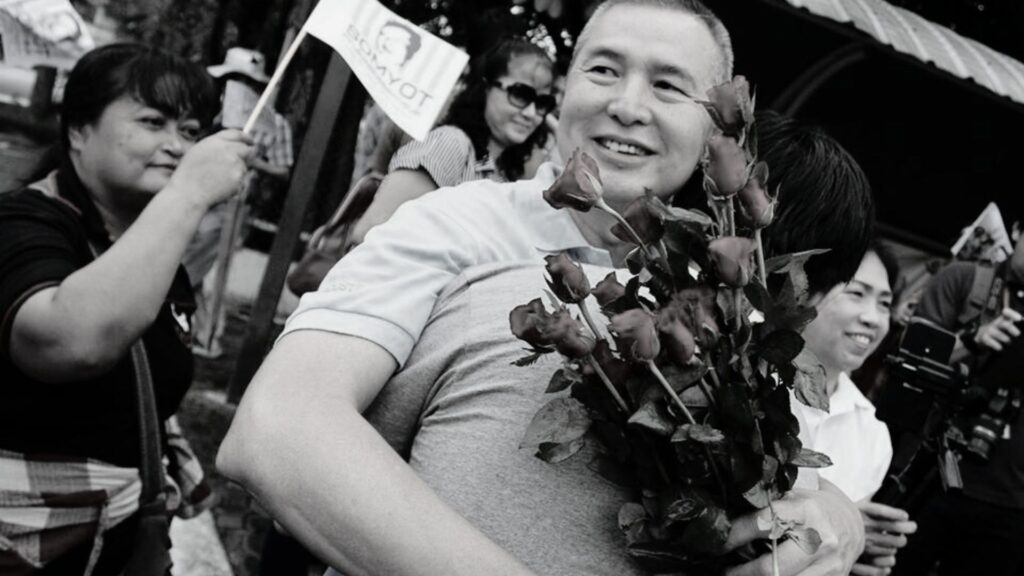
No. 35/2012: Somyot Prueksakasemsuk
Victim Name:
Somyot Prueksakasemsuk
Detention Status:
Released
Date of Adoption:
23 November 2012
Categories:
Category 2: Detention resulting from the exercise of fundamental freedoms guaranteed by international law
Overview & Facts
Information on the Violation of Rights
- Somyot Prueksakasemsuk is a labor activist, human rights defender, and a magazine editor affiliated with the Democratic Alliance of Trade Unions. He was charged under the Criminal Code, Section 112 (Lèse-Majesté) for permitting the publication of two articles in his magazine that allegedly contained negative references to the monarchy. His arrest was conducted five days after he held a press conference seeking a parliamentary review of Section 112.
- On 30 April 2011, Somyot was arrested in Aranyaprathet District, Sa Kaeo Province, and charged under Section 112 of the Criminal Code. His arrest occurred five days after he held a press conference in Bangkok to launch a campaign to collect 10,000 signatures petitioning Parliament to review Section 112.
- The charges were also reportedly based on permitting the publication of two articles in his magazine that allegedly contained negative references to the monarchy.
- On 1 November 2011, the Court denied his fourth bail request.
- Somyot was initially placed in Bangkok Remand Prison, then transferred to Sa Kaeo Provincial Court on 12 November 2011.
- The Court concluded the hearings in the case against Somyot on 3 May 2012 and denied his application for bail. The verdict was scheduled to be delivered on 19 September 2012. If convicted, Somyot faced a maximum sentence of 30 years’ imprisonment.
WGAD Opinions
Arbitrary Detention under Category II: Exercise of Fundamental Freedoms under International Law
- The Working Group finds that Somyot’s detention constitutes arbitrary detention under Category II because his detention stemmed from his exercise of the freedom of expression, contravening ICCPR Article 19.
- His actions—namely, launching a campaign to seek a review of Section 112 of the Criminal Code and permitting the publication of articles containing references critical of the monarchy—fall within the scope of opinion and expression protected under Article 19 of the Universal Declaration of Human Rights and Article 19 of the International Covenant on Civil and Political Rights.
- The Working Group also recalls that the United Nations High Commissioner for Human Rights has expressed concern about the ongoing trials and harsh sentencing of individuals convicted of lèse majesté in Thailand, as well as the resulting chilling effect on freedom of expression in the country. The High Commissioner emphasized that such severe criminal sanctions are neither necessary nor proportionate and are inconsistent with Thailand’s international human rights obligations.
- The Working Group further recalls that the holding and expression of opinions—including those that diverge from official government policy—are protected under Article 19 of the Universal Declaration of Human Rights and Article 19, paragraph 2, of the International Covenant on Civil and Political Rights. In its General Comment No. 34 (2011) on freedoms of opinion and expression, the Human Rights Committee reaffirmed that “the mere fact that forms of expression are considered to be insulting to a public figure is not sufficient to justify the imposition of penalties, albeit public figures may also benefit from the provisions of the Covenant. Moreover, all public figures, including those exercising the highest political authority such as heads of state and government, are legitimately subject to criticism and political opposition”. The Committee has therefore expressed particular concern regarding laws such as lèse majesté provisions.
WGAD Requests to the Thai Government
- The Working Group requested the Government to take all necessary steps to remedy Somyot’s situation and bring it into conformity with the standards and principles set forth in the International Covenant on Civil and Political Rights.
- The Working Group considered that the adequate remedy would be to release Somyot and accord him an enforceable right to compensation in accordance with article 9, paragraph 5 of the International Covenant on Civil and Political Rights.
International LEGAL FRAMEWORK:
- International Covenant on Civil and Political Rights (ICCPR)
- Article 9: Right not to be subjected to arbitrary arrest or detention (and the right to be brought promptly before a judge)
- Article 19: Right to freedom of opinion and expression
- Universal Declaration of Human Rights (UDHR)
- Article 19: Right to freedom of opinion and expression
- Article 21: Right to democratic participation