
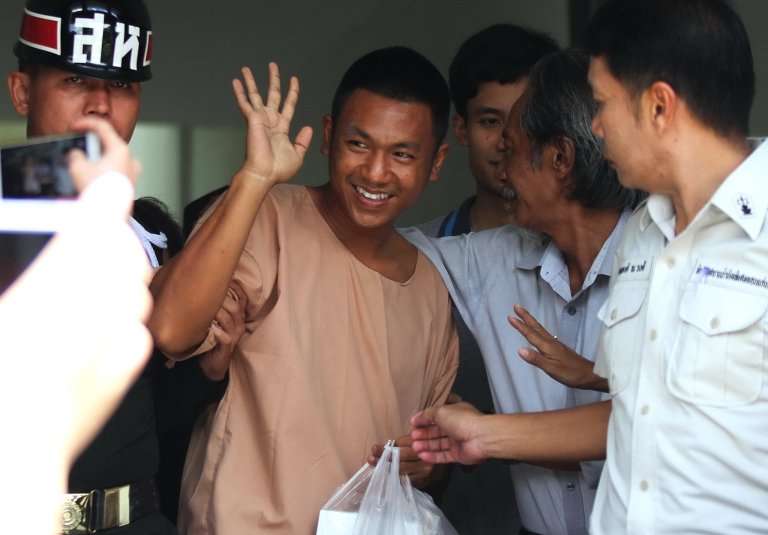
UA THA 1/2017: “Pai” Jatupat Boonpatararaksa
Name:
“Pai” Jatupat Boonpatararaksa
Case/Violation Status:
Concluded
Date of Communication:
24 January 2017
Mandates:
- Special Rapporteur on the promotion and protection of the right to freedom of opinion and expression
- Special Rapporteur on the situation of human rights defenders
Overview & Facts
Victim Profile
- “Pai” Jatupat Boonpatararaksa is a pro-democracy activist and human rights defender from Khon Kaen province. He is a member of the Dao Din group and the New Democracy Movement (NDM). He has played a key role in peaceful demonstrations following the 2014 coup and subsequent pro-democracy movements.
.
The Incident and Arrest
- On 3 December 2016, he was arrested by plainclothes police officers. He was charged under Section 112 (lèse-majesté) of the Criminal Code and Section 14(3) Computer Crime Act.
- He was detained at the police station overnight and was initially denied access to his lawyers, despite Thai Lawyers for Human Rights (TLHR) arranging legal assistance. Authorities cited concerns over “national security” and described the case as “sensitive.”
- On 4 December 2016, police officers brought Pai before the Khon Kaen Provincial Court to request permission to detain him during the investigation. The Court approved a 12-day detention (4–15 December 2016) but allowed his provisional release on bail with a surety of 400,000 Baht.
.
Bail Revocation
- On 16 December 2016, the investigating officer submitted a petition to the Court requesting the revocation of Pai’s bail, alleging that he continued posting messages on social media mocking state authority, including one stating: “The economy is bad, they’re only taking bail money.” On 22 December 2016, the Khon Kaen Provincial Court held a private hearing on the petition, barring public attendance, and ordered the revocation of bail, remanding him in custody pending trial.
- On 27 December 2016, the Court of Appeals Region 4 upheld the lower court’s order, reasoning that Pai had neither deleted the social media post nor ceased expressing opinions mocking state authority, which the Court considered disrespectful to the law and potentially harmful to the country. The Court further noted that, if convicted, Pai faced a maximum prison sentence of up to 15 years.
.
Judgment of the Court of First Instance
- On 15 August 2017, the Court scheduled the reading of the verdict in secret, ordering those not involved to leave the courtroom, before the Court read only the penalty section without reading the full legal reasoning. The Court found that Pai was guilty under Criminal Code Section 112 (lèse-majesté) and Section 14(3) of the Computer Crime Act, which constituted a single act violating multiple laws. The Court imposed the heaviest penalty, sentencing him to 5 years in prison However, due to the defendant’s confession, the sentence was reduced by half, resulting in a final sentence of 2 years and 6 months in prison. As neither party filed an appeal, the case reached its conclusion.
.
Parole Request and Administrative Lawsuit
- While incarcerated, Pai submitted a request for parole in accordance with Ministry of Justice regulations. The sub-committee responsible for parole consideration reviewed the request on 30 January 2019 but neither approved nor rejected it, citing the pending political case. At a subsequent meeting on 27 February 2019, the sub-committee voted not to approve parole, reasoning that the circumstances of the offense affected the nation’s core institutions.
- Pai then filed a lawsuit with the Central Administrative Court on 26 April 2019, seeking to revoke the resolution. However, on 5 September 2022, the Court dismissed the lawsuit, ruling that parole was at the discretion of the sub-committee and that the denial constituted a lawful exercise of that discretion.
.
Release
- On 10 May 2019, prior to the Administrative Court’s judgment, Pai was released from Khon Kaen Special Correctional Institution under a Royal Pardon dated 3 May 2019, having been detained for a total of 870 days, or 2 years, 4 months, and 20 days.
OPINIONS OF THE SPECIAL RAPPORTUERS:
- The Special Rapporteurs expressed concern at the arrest and detention of Pai and the charges brought against him under Section 112 (lèse-majesté) of the Criminal Code and under the Computer Crime Act. In their view, these provisions represent a criminalization of legitimate expression and are therefore incompatible with Thailand’s obligations under international human rights law.
- The Special Rapporteurs further expressed concern that the court hearing concerning the revocation of bail took place behind closed doors, which is in contradiction to the right to a fair and public hearing, as enshrined in Articles 9 and 14 of the International Covenant on Civil and Political Rights (ICCPR). They also emphasized the incompatibility of the application of Section 112 of the Criminal Code and the Computer Crime Act with Article 19 of the ICCPR.
- The Special Rapporteurs reiterated the crucial principle that all public figures, including those exercising the highest political authority such as the heads of State, are legitimately subject to criticism and political opposition. They stressed that defamation laws—including lèse-majesté and general defamation—must not be used, in practice, to stifle freedom of expression (General Comment No. 34), or suppress legitimate expression.
- The Special Rapporteurs stated that the application of these legal provisions creates a “chilling effect” on the legitimate exercise of the right to freedom of expression in Thailand, which is essential to a democratic society.
INFORMATION REQUESTED BY THE SPECIAL RAPPORTEURS:
- Please provide the details of the proceedings against Mr. Boonpatararaksa and the legal basis upon which he was sentenced, and explain how these are compatible with the international norms and standards.
- Please provide information of any measures taken to ensure the due process and fair trial rights of Mr. Boonpatararaksa.
- Please provide information about how the expressions made by Mr. Boonpatararaksa on social media amount to “damage to the nation,” justifying the denial of release on bail.
- Please provide information about the justifications for the use of lèse-majesté provisions to protect Thailand’s national security, and how the existence of the lèse-majesté law is related to a genuine purpose of, and demonstrates in effect, protecting the country’s existence or its territorial integrity against the use of force.
- Please provide information about any measures taken to repeal the lèse-majesté provision in Article 112 and to revise the Computer Crime Act, in order to bring these provisions in conformity with international human rights law.
International LEGAL FRAMEWORK:
- International Covenant on Civil and Political Rights (ICCPR)
- Article 9: Right not to be subjected to arbitrary arrest or detention
- Article 14: Right to a fair trial
- Article 19: Right to freedom of opinion and expression
- Universal Declaration of Human Rights (UDHR)
- Article 9: Prohibition of arbitrary arrest, detention or exile
- Article 10: Right to a public and fair hearing by an independent and impartial tribunal
- UN Declaration on Human Rights Defenders
- Article 1: Right to promote and protect human rights and fundamental freedoms without intimidation
- Article 2: Right to work with others and to participate in organizations to promote and protect human rights and fundamental freedoms
- Article 5: Right to meet or assemble, express, and access information