
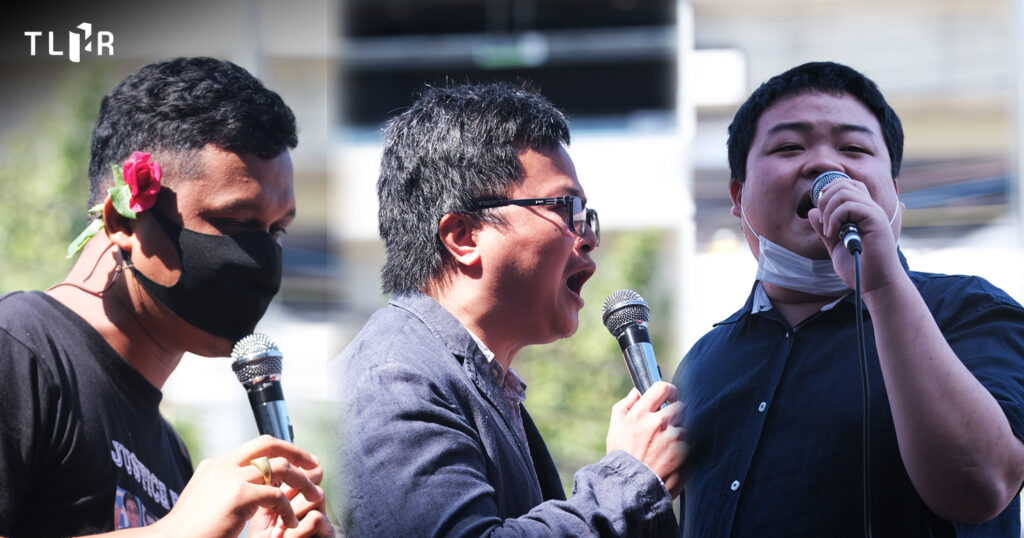
AL THA 11/2020: Section 112 Prosecution of at least 40 Peaceful Protesters
Name:
At least 40 political protesters and individuals, such as Arnon Nampa, Panupong Jadnok, Parit Chiwarak, Tattep Ruangprapaikitseree, and Jutatip Sirikhan
Case/Violation Status:
Ongoing
Date of Communication:
11 January 2021
Mandates:
- Special Rapporteur on the rights to freedom of peaceful assembly and of association
- Working Group on Arbitrary Detention
- Special Rapporteur on the promotion and protection of the right to freedom of opinion and expression
- Special Rapporteur on the situation of human rights defenders
Overview & Facts
Information on Violations of Rights
- On 17 September 2020, peaceful assemblies calling for a new constitution, reform of the monarchy, and the resignation of Prime Minister Prayut Chan‑o‑cha took place across Thailand. The largest gatherings occurred in Bangkok between 14–18 October 2020 and 17–18 November 2020.
- During the protests on 16 October, 8 November, and 17 November 2020, there were reports that police and other state forces used tear gas and high‑pressure water cannon to disperse crowds — often without issuing warnings that gave protesters sufficient time or space to disperse safely. There were also allegations of excessive force and instances of journalists being prosecuted while performing their reporting duties.
- On 17–18 November 2020, the national Parliament convened to consider amendments to all seven draft constitutions. On 17 November 2020 — the same day — a large demonstration formed outside the Parliament building. In the morning, a group calling themselves “Loyal Thais” held a counter‑protest near the Parliament to oppose the constitutional amendments and submitted demands to the President of the Senate.
- Later that afternoon, a group known as “People’s Liberation” began demonstrating nearby. Police erected barricades and used chemically‑treated high‑pressure water cannons to prevent the protesters from reaching the barriers. Protest leaders reportedly attempted to negotiate with authorities several times, but the authorities did not respond. Around 5:00 PM, police abruptly withdrew from the Kiakkai intersection without prior notice, triggering clashes between members of the two opposing groups. Protesters allegedly threw water bottles, stones and other objects. While authorities regained control within about 30 minutes, reports suggest six individuals — all participants in the “People’s Liberation” group — sustained gunshot wounds. Police launched an investigation, but no results had been publicly released as of the time of reporting. A further demonstration took place in front of the main headquarters of the national police on 18 November 2020.
- On 19 November 2020, Prime Minister Prayut announced that the government would employ “every law” against the protesters. Subsequently, authorities re‑activated prosecutions under the country’s lèse‑majesté law — Section 112 of the Criminal Code — filing charges against at least 40 individuals, including minors aged 16 and 17. According to the Deputy Commissioner of the Bangkok Metropolitan Police, as of 14 December 2020, at least 41 people were facing prosecution; some were charged with multiple counts under Section 112. Among those charged were known protest leaders such as Parit Chiwarak, Panupong Jadnok and Arnon Nampa.
- In addition, at least three individuals were charged under Section 110 of the Criminal Code — which punishes acts of violence against the Queen’s liberty — a rarely used and serious offense under Thai law. Some protest organizers and participants, including teenagers, faced additional charges under the Emergency Decree on Public Administration in Emergency Situations, B.E. 2548 (2005) and under Section 116 of the Criminal Code.
OPINIONS OF THE SPECIAL RAPPORTUERS:
- The Special Rapporteurs are of the view that no individual should be criminally prosecuted for peacefully expressing themselves in assemblies or for exercising their right to freedom of expression in defense of human rights. If the allegations contained in the communication are confirmed, the alleged acts would constitute violations of international human rights law, in particular Articles 19 and 21 of the International Covenant on Civil and Political Rights (ICCPR).
- The Special Rapporteurs expressed concern regarding the use of Section 112 of the Criminal Code to suppress civic space and create a “chilling effect” on peaceful protesters. They highlighted ongoing concerns regarding the application of the lèse‑majesté law, which they have previously raised in communications to the Thai Government, including AL THA 7/2020, AL THA 1/2020, UA THA 1/2017, and UA THA 7/2017. They emphasized the need to apply Section 112 and the Computer Crime Act in conformity with Article 19 of the ICCPR. The Special Rapporteurs reminded the Government, in line with General Comment No. 34 of the Human Rights Committee, that public figures — including those exercising political authority such as heads of state — are legitimately subject to criticism and political dissent, and that criticism of public figures alone cannot justify criminal penalties against individuals.
- The Special Rapporteurs also expressed concern about the prosecution of high school students, who are minors, under serious charges such as lèse‑majesté or sedition.
- Furthermore, the Special Rapporteurs raised concerns regarding the use of force by authorities, including the deployment of water cannons with chemical irritants against protesters. They underscored that the Government has an obligation to ensure that any use of force during assemblies is necessary and proportionate, and to protect peaceful protesters from violence by other groups.
INFORMATION REQUESTED BY THE SPECIAL RAPPORTEURS:
- Please provide any additional information and/or comment(s) on the communication presented by the Special Rapporteurs.
- An explanation of all the factual circumstances and the legal basis relevant to the legal proceedings against the aforementioned individuals.
- An explanation of the circumstances under which speech and participation in peaceful assembly, as well as calls for peaceful political change, would be considered an offence under Section 116.
- An explanation from the Thai Government regarding what kind of peaceful calls for political change or constitutional reform, or participation in peaceful protests, would be considered an act constituting sedition, citing the Government’s reply of 25 November 2020: “The law is only used to target illegal activities and the dissemination of false information.”
- Measures taken to comply with the recommendation of the Human Rights Committee to cease the application of lèse-majesté laws, the Computer Crime Act, sedition laws, and other regulations that restrict the freedom of expression and freedom of peaceful assembly.
- Information on any measures taken to abolish the lèse-majesté provision under Section 112 and to amend the Computer Crime Act to bring these provisions into compliance with international human rights law.
- Information on the status of the investigation into the injuries that occurred on 17 November 2020 in Bangkok.
International LEGAL FRAMEWORK:
- International Covenant on Civil and Political Rights (ICCPR)
- Article 9: Right not to be subjected to arbitrary arrest or detention
- Article 14: Right to a fair trial
- Article 19: Right to freedom of opinion and expression
- Article 21: Right to freedom of peaceful assembly
- Article 22: Right to freedom of association